Crimson Desert’s 77 Metascore Sparks Industry Reckoning Over Review Embargos and Day-One Patches
Pearl Abyss executive Lybee Park acknowledges pre-launch review conditions and missing day-one patches impacted Crimson Desert's 77 Metascore as sales pass 5 million.
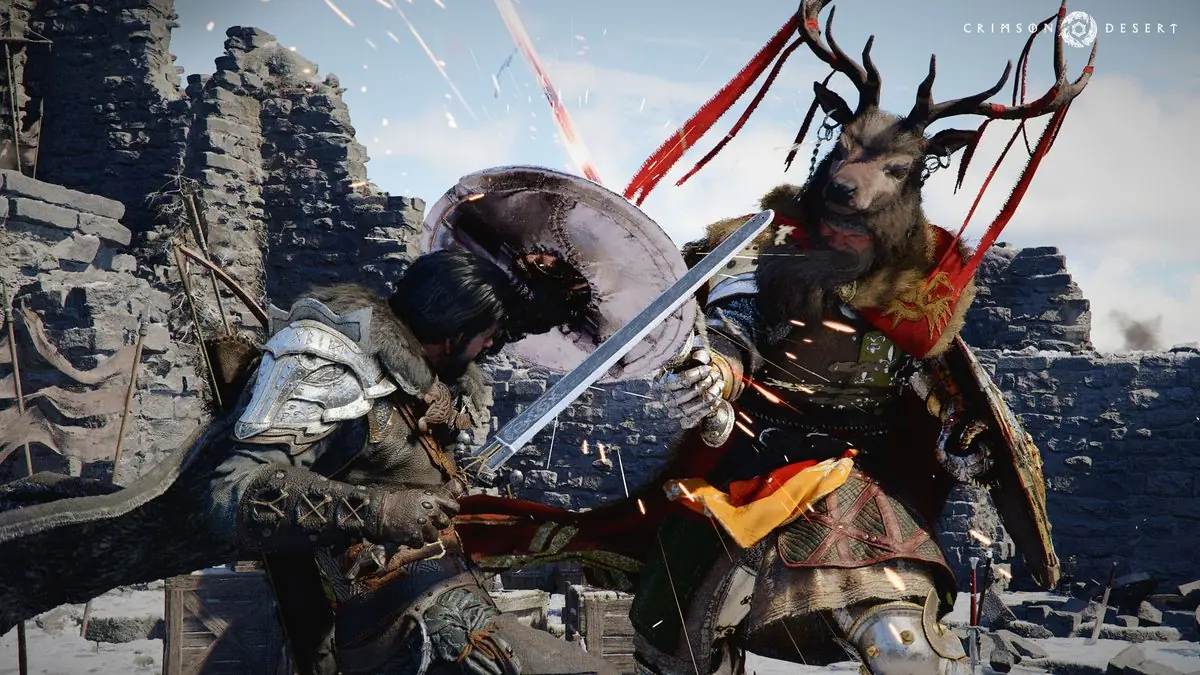
The critical reception of Pearl Abyss’s open-world epic Crimson Desert has exposed an enduring friction within video game journalism. Speaking in an interview with industry outlet The Game Business, Lybee Park, chief executive officer of Pearl Abyss Europe, acknowledged that the title's aggregate score of 77 on Metacritic was significantly distorted by review conditions, pointing directly to compressed embargo windows and the absence of critical launch-day code.
Yet while the critical consensus hovered in mixed-to-positive territory, consumer adoption told a starkly different story. The South Korean studio confirmed that Crimson Desert crossed 5 million full-copy sales in roughly one month, with recent industry estimates tracking above 6 million units. The divergence between initial press verdicts and audience reception highlights how traditional embargo timelines struggle to measure sprawling, systems-heavy sandboxes.
The Two-Week Race Across Pywel: Why Mainline Rushes Distort Massive Sandboxes
For media outlets reviewing Crimson Desert, the embargo window provided approximately two weeks to dissect the continent of Pywel. In modern editorial environments where staff writers balance daily news obligations alongside hundred-hour campaign assessments, comprehensive non-linear exploration becomes an operational impossibility.
Park directly addressed this procedural reality when detailing how reviewers approached the game. "I think both sides have fair points, especially the critics. They had to play a version that wasn't exactly the launch version," Park stated. "On top of that, they had limited time. Normally the classic approach to a review is to follow the main line, but in Crimson Desert our unique charm is scattered all over the game world. All these little hidden details, the freedom to explore beyond common expectations."
That structural bias toward the golden path left entire layers of interactive design uninspected. "All these unique and new details, I don't think critics had a fair chance to explore and experience them during the review periods," Park added. While outlets like TheGamer awarded four stars and commended the expansive terrain and kinetic combat, more tepid evaluations flagged uneven narrative pacing and systems density—criticisms heavily amplified when an open world is consumed under a race to beat a publication deadline.
The Pre-Patch Dilemma and the Fragility of Unfinished Review Builds
Beyond time constraints, the build distributed for critique lacked essential baseline engineering. Pearl Abyss issued review codes exclusively on personal computer storefronts without integrating the Day One patch, prompting the developer to advise retail purchasers to install the update prior to their initial playthrough.
The gap between pre-embargo code and launch software has become an industry-wide liability for premier releases. Large-scale role-playing productions rely on zero-hour stability fixes, quest scripting adjustments, and graphical pipeline optimizations that frequently resolve the very friction points highlighted in pre-release copy. When reviewers evaluate unpolished software, aggregate registries crystallize flaws that paying consumers never encounter.
Market Volatility and the High Cost of Aggregate Benchmarks
The stakes of compressed critique extend well beyond review scoreboards. Following the embargo lift on March 19, shares of Pearl Abyss plunged between 27% and 30% on South Korea’s KOSDAQ exchange as the aggregate score debuted at 78 before settling at 77. For institutional investors anticipating an 85-plus benchmark to validate a seven-year development timeline and an estimated 200 billion won ($150 million) production budget, the aggregate metric prompted immediate financial panic.
The subsequent rebound in equity arrived only after audited retail figures verified commercial velocity. The initial market shock demonstrates the disproportionate leverage exerted by aggregate trackers, penalizing independent developers for technical vulnerabilities that standard post-launch cycles resolve within hours of public access.
Confirmed Roadmaps and the Unresolved Friction of Industry Deadlines
Pearl Abyss has addressed critique through rapid post-launch iteration. The developer deployed the complimentary "Crimson Desert Enhanced" update to introduce expanded narrative sequences and revised character dialogue, while scheduling the game's first major story expansion, "Charting the Unknown," for release on October 29, 2026.
What remains unresolved is the broader structural logistics governing game reviews. Pearl Abyss has not announced alterations to its distribution protocols for future releases, and platform aggregators maintain frozen pre-launch calculations alongside retail customer feedback. Until publishing schedules reconcile compressed review cycles with hundred-hour sandbox designs, pre-release scores will continue to capture the limits of publication deadlines rather than the longevity of the game world.
Was this article helpful?
Your feedback helps our editorial team refine reporting depth and accuracy.
Related Articles
Aug 22, 2026
Gears of War: E-Day Sells 230,000 Copies as Game Pass Cannibalization Debate Reignites
Alinea Analytics reports Gears of War: E-Day sold 230,000 copies as 1.7M played via Game Pass, with $30 early access upgrades driving $37M launch revenue.
Aug 21, 2026
Konami Confirms Second and Third Waves of Silent Hill Projects Following Townfall Release
Series producer Motoi Okamoto confirms in Famitsu that Konami is evaluating pitches for second and third waves of Silent Hill after wrapping Townfall.
Aug 19, 2026
PS5SX2 Enables Physical PS2 Disc Playback on Jailbroken PlayStation 5 Hardware
Homebrew emulator PS5SX2 v2.02 introduces physical PS2 DVD playback directly through the PlayStation 5 optical drive, exposing hardware constraints and Sony's retro ecosystem policies.