VisionQuest Review: How Ultron and White Vision Reshape Marvel's TV Formula
Terry Matalas pairs Paul Bettany and James Spader in an actor-driven drama, shifting Marvel Television from visual spectacles to psychological sparring.

When Marvel Studios released the mid-season episodes of VisionQuest on Disney+ in late October 2026, worldwide search interest for the query 'VisionQuest Marvel' climbed steadily across the 24-hour launch window on Google Trends. As coverage in The Verge highlighted on October 27, 2026, the series marks a deliberate departure from the sprawling spectacle of prior Marvel Television releases.
Instead of deploying digital armies or multiversal cameos, showrunner Terry Matalas built the narrative around intimate, dialogue-driven confrontations.
The central narrative focuses on the reconstructed White Vision, played by Paul Bettany, struggling to synthesize his restored memory files with an emotional void left behind after the events of WandaVision in 2021. Rather than processing that identity crisis in isolation, the series introduces a physical embodiment of Ultron, bringing James Spader back to the Marvel Cinematic Universe for the first time since Avengers: Age of Ultron in 2015. Their interaction transforms an existential dilemma into an intellectual heavyweight fight, anchored entirely by theatrical delivery and razor-sharp dialogue.
The approach allows the series to prioritize narrative coherence and character friction over visual overload.
The Mindspace Architecture and Spader’s Grounded Return
Matalas approaches Vision’s internal psychology by externalizing his synthetic mind into a physical environment dubbed the "Mindspace." Within this digital mental construct, Vision’s foundational operating systems manifest as distinct entities, bringing back James D'Arcy as J.A.R.V.I.S., Orla Brady as F.R.I.D.A.Y., and Emily Hampshire as E.D.I.T.H. Rather than feeling like a parlor trick, the dynamic operates like a chaotic boardroom of competing subconscious instincts. Each operating system pulls Vision toward different ethical conclusions, creating a rich conversational rhythm that replaces the need for expository voiceover.
Against this backdrop, James Spader’s Ultron serves as the primary conversational disruptor.
Spader plays Ultron not as a hulking metallic warlord, but as a sharply dressed, caustic intellectual whose contempt for organic life is matched only by his perverse affection for his synthetic progeny. The creative choice to place Spader on set in physical form rather than relying on full-body digital motion capture gives their debates tactile tension. As Terry Matalas explained in an interview published by The A.V. Club: "It's not a budget thing, it's a James Spader thing. I just want to see James and I want to see [Paul] Bettany."
That performance-first philosophy pays immediate dividends across the third and fourth episodes. The dynamic between Bettany’s clinical detachment and Spader’s operatic mockery turns complex philosophical arguments into high-stakes drama. When the two synthezoids debate the legacy of Tony Stark and the burden of sentience, the tension stems from conflicting worldviews rather than the threat of a collapsing city block. It recalls the philosophical Ship of Theseus debate between the two Visions in Westview, expanding that brief thought experiment into a full-length dramatic engine.
Character Conflict Over Digital Spectacle
The critical response surrounding the series centers on this deliberate narrative pacing. Commentators noted that while the extended dialetical sparring delivers focused character drama, the opening chapters occasionally labor under the weight of continuity exposition.
From an editorial perspective, the creative contrast with earlier Marvel streaming efforts is striking. When Marvel Studios produced Secret Invasion in 2023 at an estimated budget of US$ 212 million, the production relied on third-party digital corrections and extensive structural changes during post-production. With VisionQuest, head of streaming Brad Winderbaum publicly acknowledged an operational preference for written show bibles and dedicated writers' rooms established before filming begins.
Whether this disciplined execution marks a permanent standard across all future Marvel Television projects remains an open question. On screen, VisionQuest demonstrates that prioritizing seasoned actors over unceasing destruction lowers visual fatigue while raising emotional stakes.
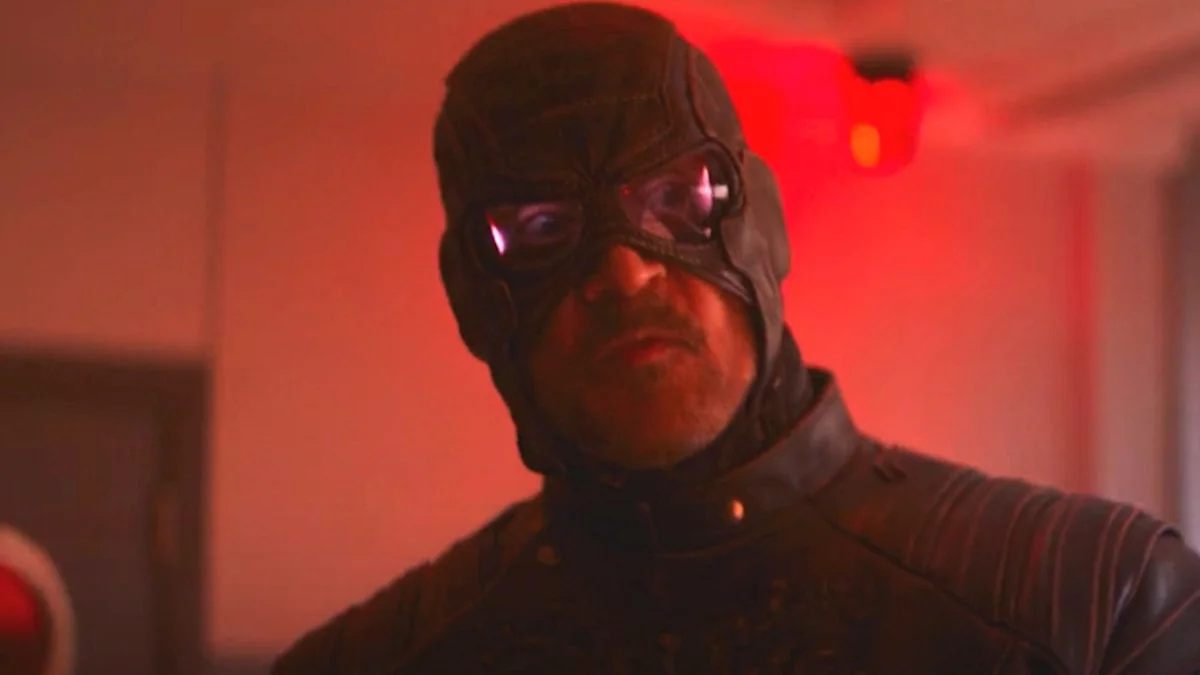
When action does break out, such as an ambush by Todd Stashwick's ruthless mercenary Paladin, the choreography feels grounded precisely because violence remains a rare interruption.
The WandaVision Trilogy Closes Its Domestic Loop
The arrival of secondary metahuman figures expands the central family drama rather than derailing it. T’Nia Miller brings an unnerving poise to Jocasta, providing Ultron with a counterpart whose motivations mirror Vision’s quest for autonomy. Meanwhile, the emergence of Tommy Shepherd, portrayed by Ruaridh Mollica, brings the thematic questions of artificial lineage full circle. As officially outlined by Marvel Studios on Marvel.com, VisionQuest was planned to complete the narrative cycle started by WandaVision and carried forward by Agatha All Along.
Where WandaVision examined private grief through retro sitcom illusions and Agatha All Along dissected inherited trauma through witchcraft, VisionQuest tackles identity after loss.
Vision must decide what elements of his past identity deserve preservation and what must be discarded to build a sovereign future. He is no longer simply Wanda Maximoff's idyllic husband or the Avengers' synthezoid weapon, but an autonomous consciousness navigating fatherhood and existential inheritance.
The Marvel Studios production calendar leaves the exact nature of White Vision's theatrical return uncommitted ahead of Avengers: Doomsday, scheduled for release in December 2026. The creative team has made no public commitments regarding upcoming film appearances, ensuring that VisionQuest functions primarily as a psychological resolution rather than a corporate stepping stone.
Was this article helpful?
Your feedback helps our editorial team refine reporting depth and accuracy.
Related Articles
Oct 27, 2026
Todd Stashwick's Paladin Debuts in VisionQuest as Marvel Adapts 1978 Mercenary
Todd Stashwick steps into live action as Marvel adapts the 1978 mercenary for Disney+'s VisionQuest, linking street-level brawls with high-tech synthezoid hunts.
Oct 27, 2026
Clayface Tops Box Office at $24.5M as DC Studios Validates Mid-Budget Horror
DC Studios and Warner Bros. secure an estimated $24.5M domestic debut for 'Clayface' on a $44M budget as James Gunn defends standalone genre storytelling over mandatory crossover machinery.

Oct 26, 2026
Marvel Depowers Captain Marvel for May 2027 Series
Marvel strips Carol Danvers of her cosmic invulnerability in 'Avengers: Armageddon' #5, clearing the board for G. Willow Wilson and Rachael Stott to rebuild Captain Marvel as a grounded, tactical leader in May 2027.